Use percentages, then choose a batch weight
If a trial formula is written as percentages, you can change the batch size without changing the proportions. Calculate each row with:
Ingredient grams = formula percentage ÷ 100 × batch grams
Use the total batch weight in grams. A 1 kg batch is 1,000 g. This calculation says nothing about the liquid volume or the number of bottles you can fill.
From a 10 g trial to a 1 kg batch
The following materials are arithmetic placeholders, not a perfume recipe. Their percentages add to 100.
| Material | Formula | 10 g trial | 1,000 g batch |
|---|---|---|---|
| Material A | 10% | 1 g | 100 g |
| Material B | 25% | 2.5 g | 250 g |
| Material C | 65% | 6.5 g | 650 g |
| Total | 100% | 10 g | 1,000 g |
The larger batch is 100 times the trial weight, so every row increases by the same factor. Round only to a precision your scale can reliably measure. Rounding each row too early can make the final weights drift away from the target.
Build the worksheet
- Open Perfume Maker Studio and name the formula or revision.
- Enter 1000 as the batch size in grams.
- Add the materials and enter their percentages. Check the total before you use the amounts as a weighing list.
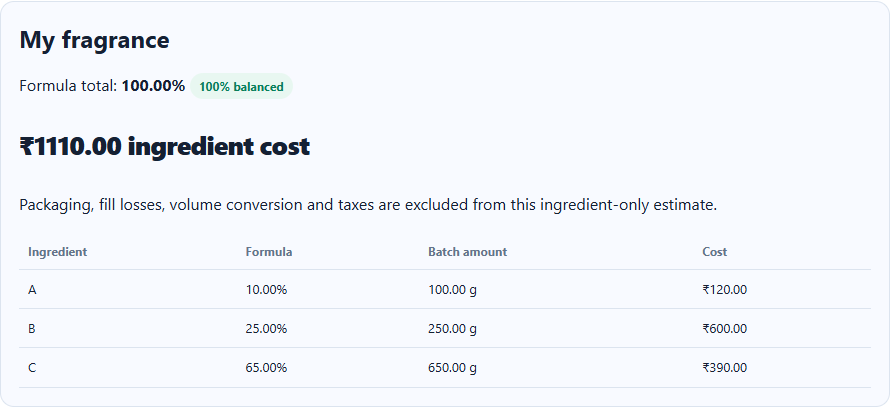
- If you want an ingredient-cost estimate, enter each supplier cost per kilogram in the same currency.
- Check the ingredient weights and costs in the result table.
- Download the CSV worksheet or print a copy. Compare it with the original formula before weighing.
A separate check for material cost
Assume the example materials cost ₹1,200, ₹2,400 and ₹600 per kilogram. For the 1 kg batch:
| Material | Weight | Cost per kg | Batch cost |
|---|---|---|---|
| A | 0.10 kg | ₹1,200 | ₹120 |
| B | 0.25 kg | ₹2,400 | ₹600 |
| C | 0.65 kg | ₹600 | ₹390 |
| Total | 1.00 kg | ₹1,110 |
The cost formula is ingredient grams ÷ 1000 × cost per kg. A 100 g batch with those same inputs would cost ₹111 in ingredients.
This estimate excludes bottles, caps, labels, losses, labour, delivery and taxes. Use the bill of materials cost builder for additional components.
Do not substitute millilitres for grams
Mass and volume are different measurements. You need suitable density information for a volume conversion. Do not turn a 1,000 g worksheet into a claim that the batch fills twenty 50 ml bottles.
Likewise, drops are not a reliable substitute for weighing. Drop size varies with the liquid and the dropper.
Checks beyond the arithmetic
Scaling preserves proportions; it does not validate ingredient identity, stability or suitability for a particular product. Screen relevant materials using the IFRA ingredient checker and read its dataset and category limits. Verify the supplier documentation and the current official IFRA Standards where applicable.
Keep the formula revision and supplier material details with the batch record. The worksheet is a planning aid, not an IFRA certificate or a finished-product safety assessment.